

Test itinerary 2
dgdgdsh

Attractions to Visit
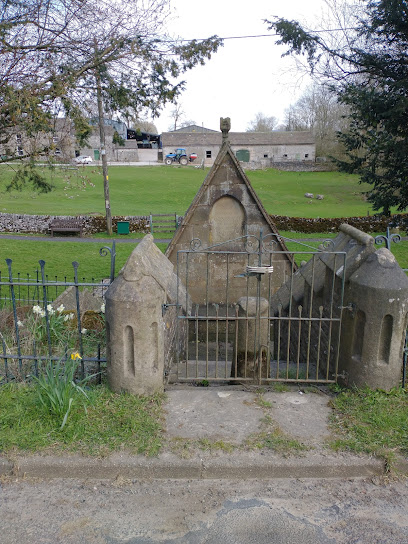
Housesteads Roman Fort
Take an atmospheric wander around the best-preserved Roman fort in Britain. Housesteads Roman Fort was once garrisoned by 1,000 soldiers. It is aligned towards sunrise, making the east gate the main gate. You can still see the deeply worn wheel ruts here. Vercovicium or Borcovicium were how the fort was known in Roman times. The museum and its introductory film give great insight about these astonishing ruins. The steep walk to the remains is worth it for the history and spectacular views. From 1663, Housesteads was the home of the Armstrongs, notorious Border Reivers. Nicholas Armstrong bought the farm in 1692, only to have to sell it again in 1694 to Thomas Gibson, of Hexham, for £485. The Armstrongs remained as tenants. They were well-known horse thieves and cattle rustlers, who used the old Roman fort as a corral for their stolen livestock. They “traded” all over. At one time, every male member of the family had been outlawed by English or Scottish authorities. Nicholas was hanged in 1704, and his brothers fled to America. The Armstrongs lived in a typical 16th century defensive bastle house of two storeys: the ground floor for livestock and the upper level for living quarters. Its ruins remain built up against the south gate of the Roman fort and clearly show its defensive nature, with external stone steps and narrow loop windows. A corn-drying kiln was inserted into the gate’s guard chamber in the 17th century.
Hadrian's Wall Walk, Carrawburgh, Newbrough NE46 4DB
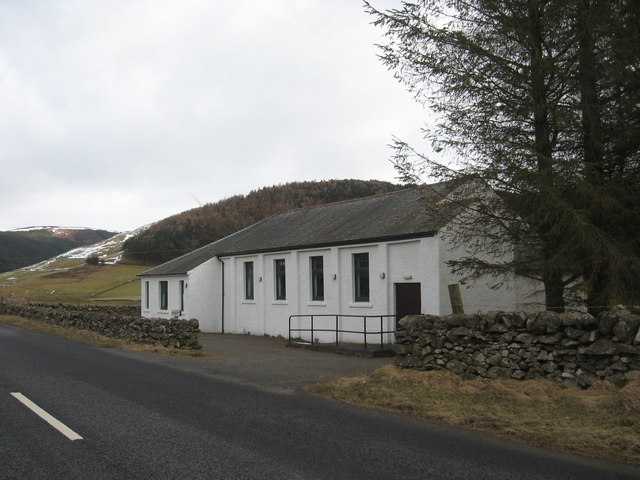
Gameshope
Park and start Park at the end of Talla reservoir, just before the steep road (Talla Linn Foots), on the grassy verge. The walk starts as you pass through the pedestrian gate at the bottom of the valley. There is an information point inside the gate, showing various points of interest. Views The footpath follows the Gameshope burn, and there are spectacular views as you make your way up the valley. The path is generally in good condition, but in some sections, water runs over the path, and there are some rocks and potholes to negotiate. As sections are tarmacked, it can be very slippy underfoot in the winter. Ice Age History This valley was under ice during the last ice age and as you look up the valley you will see the “U” shaped sides, typical of glaciation. Some of the rocks on the sides of the path also have scratch marks on them, that would have been made by rocks carried down the slope in the bottom of the glacier. You will also notice that the hills are rounded, as the glacier would have covered them completely. The river has also done some erosion on the landscape, and about halfway up the valley you will notice small round pockets cut into the rock at the side of the burn. When the burn is in spate, this will have been caused by gravel and grit carried by currents, grinding the rocks within the water. The Dam at Talla The path is tarmacked in places, as stones for the building of the dam at Talla were quarried from here in the early 1900s. There was a railway running the whole north side of Talla reservoir to take the stone to the dam. Some of the quarries can still be seen in Gameshope with piles of whinstone rocks, still in situ, that were ultimately not required during the construction of the dam. If you look carefully at some of the rocks on the top side of the path you will see some holes that were drilled to contain dynamite during quarrying. It is likely that the rocks were transported down the valley to the railway by horse drawn wooden sledges. Once the dam was completed, the railway was removed, and the track bed used as the route of the present vehicular road. The old Shepherd’s cottage at Gameshope Now managed by the Mountain Bothy Association, and is free to stay in overnight. The cottage was formerly owned by the Anderson family, and was bequeathed to the Bothy Association. To reach the bothy, you have to wade across the burn, which is not advisable when the water level is high. For centuries Talla and Gameshope was an upland sheep farm. There used to be 6 full time shepherds working here, and Gameshope was home to one or two of these men, with their families. Gameshope was purchased by Scottish Borders Trust in 2013, and all the sheep have been removed. Just beyond the bothy, past the farm shed, there is a rocky natural structure, that appears from a distance to resemble a stony fortress. Is this the site of Gameshope Castle? Peden’s Pulpit In the hills behind Gameshope Castle is Peden’s Pulpit. Grid reference: NT137183. Peden’s pulpit is a natural stone and is where Prophet Peden preached to his congregation of local covenanters, hidden from Claverhouses’s men. If you stand on top of the “pulpit’ it is easy to imagine the congregation of local covenanters gathered below, listening to his sermon.
Scottish Borders, Biggar ML12 6QR
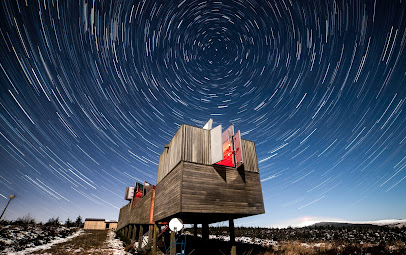
Kielder Observatory
Nestled in the Kielder Water and Forest Park in Northumberland, Kielder Observatory is a spectacular experience for all the family. At nearly 580 square miles, our dark sky zone, known at Northumberland and Kielder Water & Forest International Dark Sky Park, is the second largest area of protected night sky in Europe. Here the stargazing can be breath-taking: the ‘Kielder moment’ is very special, the moment that visitors look up at the glittering skies and realise that they’re completely connected to this vast cosmos, yet utterly unique within it. Like the deck of a ship sailing above the landscape, the Observatory provides astronomers with a permanent facility in the heart of Northumberland. It is part of the art and architecture programme that has turned Kielder Water and Forest Park into an open-air gallery over the last 10 years. The observatory hosts events to suit everyone: there are family events to entertain young explorers; relaxed events for people with different abilities; introductory events; legends behind the constellations events; and events focusing on phenomena such as the aurora, our moon, dark matter, and exoplanets. Access to the Observatory is for ticket-holders only: booking is essential and can be done via the website. The access track is 2 miles long, uncased and single lane so is only opened for events one hour before to ensure traffic up and down the track is managed properly. Visitors can walk up to the Observatory during the day and enjoy the spectacular views but there are no facilities available during the day. Close to the Observatory is James Turrell's Kielder Skyspace, a circular sculpture which is illuminated by a combination of natural and artificial light. Skyspace can be accessed via the track to the Observatory. During dusk, the LED lighting system is triggered and as the exterior light changes - the effect is a rich and unforgettable display of tone and colour. Kielder Observatory — a beacon for dark skies. Come and find your infinite inspiration. For more information about Northumberland International Dark Sky Park see our Dark Skies page. Come here to: Learn about the night sky and use the powerful telescopes. Meet experienced astronomers and learn how to take stunning photographs of distant objects in the Universe. Experience meteor showers (shooting stars) and other celestial events. Kielder Observatory is also part of the art and architecture programme. Find out more about its striking design here.
Black Fell, Kielder, Hexham NE48 1EJ